
Blockchain Development Services
Blockchain Development Services
Transform Your Future with Cutting-Edge
Blockchain Development Solutions
As a Blockchain Development Company, we empower businesses with tailored blockchain development services. Future-proof your operations with secure, innovative blockchain solutions crafted by our expert team.
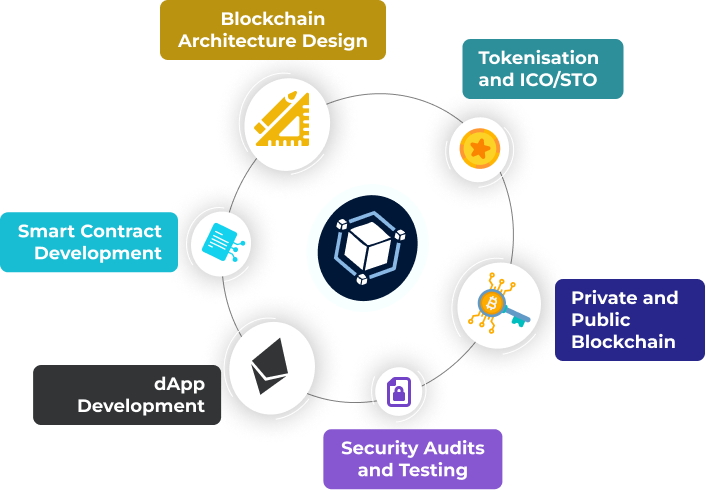
Explore our Blockchain Services

Blockchain
Integration

Seamless Customization

Value-Adding Services
Why choose Cloud Analogy as your Blockchain App Development Company?
Our expert blockchain developers deliver secure, scalable solutions tailored to your business needs.
- Specializing in decentralized applications, smart contracts, and blockchain integration across industries.
- Proficient in leveraging modern blockchain frameworks to build innovative, future-ready solutions.
- Skilled in creating dynamic blockchain platforms and feature-rich APIs.
- Expertise in seamless blockchain integration with existing systems.
- Agile methodologies ensure rapid Smart Contract Development, Cryptocurrency Development, and many more.
- A client-focused team dedicated to driving growth with customized blockchain solutions.
0
+
Projects Delivered Globally
0
+
Satisfied Clients
0
+
Experts
0
Years of Excellence
What sets us apart?
Guaranteed On-Time Delivery
High-Quality Solution Development
Flexible, No Lock-In Engagement Model
Security and Scalability
Extensive and Proven Industry Expertise
Dedicated and Responsive Customer Support
We Provide Blockchain Development Services
Blockchain helps businesses adopt new models, optimize operations, and make strategic decisions.
Blockchain Integration
Our certified Salesforce Blockchain Integrators bridge trust gaps, enabling you to share and utilize vast data seamlessly with your network of partners and third parties. Connect with our certified experts in Salesforce Blockchain Integration today.
Seamless Customization
Launching your web app is just the start; ensure its longevity with our PHP support and maintenance services. Our developers optimize performance and apply security patches, minimizing downtime and enhancing reliability.
Value-Adding Services
Create and share blockchain objects as quickly as CRM data objects—no coding needed. Our certified Salesforce blockchain experts empower you to build and share blockchain objects with simple clicks.
Advanced Blockchain Development Solutions: Driven by Innovation, Powered by Technology



















Driving Success With Digital Solutions for Every Industry

Healthcare

Retail & Ecommerce

Travel & Tourism

Professional Business

Education

Media & Entertainment

Events

Food & Restaurants

Automotive

Fashion

Finance

Real Estate
Blockchain Development: SECURE,
SCALABLE, and TAILORED to you
01Consultation & Planning
Define blockchain project scope, align with business objectives, and create a detailed development plan, including platform selection and consensus mechanisms.

02Design & Development
Develop scalable, secure blockchain solutions and integrate necessary APIs, focusing on smart contract implementation and decentralized application (dApp) architecture.
03Testing & Optimization
Implement rigorous testing, including white-box and beta testing, performance tuning, and security audits to eliminate vulnerabilities.

04Launch & Deployment
Deploy the blockchain solution to the chosen network, ensuring seamless integration with existing infrastructure and minimal disruption.
05Ongoing Support
Provide continuous monitoring, proactive maintenance, and timely updates to adapt to evolving business needs and technological advancements



Get in Touch Now!
Talk to our expert to get a custom proposal & tailored guidance!
Sales Inquiry:
info@cloudanalogy.com
Cloud Analogy
HR Inquiry:
info@cloudanalogy.com
hr-cloudanalogy
An OTP is Sent to your provided Email ID
Please Check your Inbox and Spam/Junk folder
Frequently Asked Questions
Ethereum is the most widely adopted platform for public decentralized applications and token-based ecosystems, Hyperledger Fabric suits enterprise permissioned blockchain networks where participants are known and data privacy is required, while Solana offers significantly higher transaction throughput at lower cost for applications where speed is a priority. Blockchain Development Services projects begin with a platform selection workshop that maps the business's privacy requirements, transaction volume, and consensus model needs before committing to any specific chain.
Smart Contract Development involves writing self-executing code deployed to a blockchain that automatically enforces agreement terms when predefined conditions are met, eliminating the need for intermediaries in transactions, asset transfers, or multi-party agreements. Security requires avoiding common vulnerabilities including reentrancy attacks, integer overflow errors, unchecked external calls, and improper access controls. Every smart contract should undergo professional security audits using automated analysis tools alongside manual code review before deployment since errors on-chain are immutable and cannot be patched after the contract goes live.
Public blockchains like Ethereum allow anyone to participate, read, and write transactions, offering maximum transparency but limited privacy and lower throughput. Permissioned blockchains restrict network participation to authorized parties, enabling businesses to maintain data confidentiality, control governance rules, and achieve higher transaction speeds suited to enterprise workflows. Blockchain App Development for supply chain, healthcare, and financial services industries typically favors permissioned architectures where regulatory compliance and participant identity control are non-negotiable requirements.
A focused Blockchain Development Services project covering smart contract development, basic dApp frontend, and wallet integration typically takes 8 to 14 weeks from requirements to mainnet deployment. Projects involving tokenomics design, DeFi protocol development, NFT marketplace builds, or enterprise permissioned network setup take 4 to 8 months depending on consensus mechanism complexity and the number of integrated external systems. Smart contract audit cycles add additional time that should be budgeted into every project timeline from the start.
Yes, blockchain networks connect to existing enterprise systems through middleware layers, oracle services that feed off-chain data onto the chain, and REST APIs that allow traditional databases and ERP platforms to read and write blockchain data without requiring a full system replacement. Web3 Development Services that integrate blockchain with existing infrastructure focus on defining which business processes genuinely benefit from on-chain immutability and which can remain in traditional systems, avoiding the common mistake of putting everything on-chain unnecessarily.
Smart contract audits combine automated static analysis tools like Slither and MythX with manual code review by experienced Solidity or Rust developers who inspect the contract logic for business logic errors that automated tools miss. Audit findings are categorized by severity, with critical and high-severity issues requiring remediation and re-audit before mainnet deployment. Blockchain App Development projects that skip security audits are among the most common sources of multi-million dollar protocol exploits, making auditing a non-negotiable step rather than an optional quality check.
DeFi applications introduce financial protocol logic including liquidity pools, yield calculations, oracle price feed integration, governance token mechanics, and flash loan protections that standard blockchain applications do not require. This complexity dramatically increases the surface area for security vulnerabilities and requires developers with specialized DeFi protocol experience beyond standard smart contract development. A Blockchain Development Company delivering DeFi products should demonstrate audited protocol experience rather than general Solidity development background since financial protocol errors carry outsized financial risk compared to non-financial smart contracts.
Gas fees on networks like Ethereum directly influence how frequently users can afford to interact with a smart contract, making transaction batching, Layer 2 deployment on networks like Arbitrum or Optimism, and off-chain computation with on-chain settlement important architectural decisions for any application expecting high user interaction volume. Applications designed without considering gas costs often become economically unviable once mainnet gas prices spike during periods of high network congestion. Web3 Development Services teams evaluate gas optimization strategies during architecture design rather than treating it as a post-deployment concern.
A capable Blockchain Development Company should demonstrate audited smart contract deployment experience, hands-on knowledge of the specific blockchain platforms relevant to the project, and a track record of delivering security-first builds rather than speed-first builds that accumulate vulnerabilities. Ask about their smart contract audit process, how they handle post-deployment contract upgrades when business logic needs to change, and whether they have experience with the specific use case, whether DeFi, NFT, supply chain, or enterprise permissioned networks, rather than only general blockchain development background.