
Salesforce Commerce Cloud Services
Salesforce Commerce Cloud Services
Make The Most Of Salesforce Commerce Cloud & Skyrocket Your eCommerce Success To New Heights.
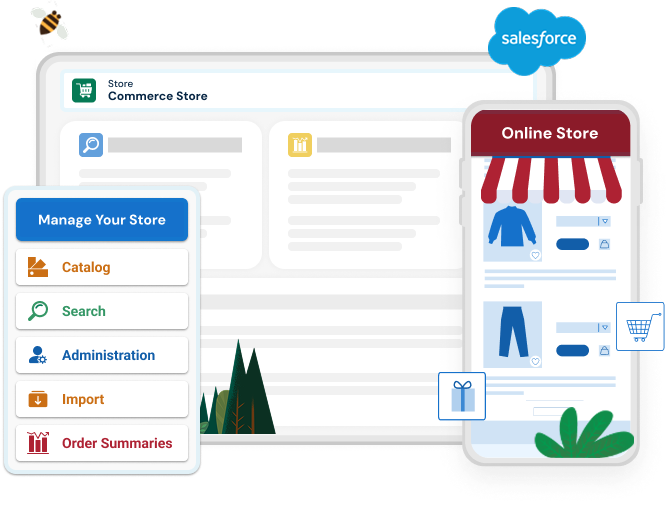
Globally Trusted for Delivering High-Impact Salesforce ROI






Salesforce Commerce Cloud Is A Game-Changer For Modern Businesses
In the rapidly changing e-commerce world, consistent support and improvement are vital for remarkable success. And this is where Cloud Analogy, a trusted Salesforce Commerce Cloud company, becomes your winning formula that can work wonders for your business.
When you choose Cloud Analogy’s Salesforce Commerce Cloud experts, we’ll be there for you at every stage of your e-commerce journey.
Tailored Strategy Meets Business Goals

Smooth Implementation Ensures Easy Adoption

Continuous Support And
Fine-Tuning

Why Commerce Cloud For Your
Ecommerce Business Model?
By leveraging Salesforce Commerce Cloud, you can address the specific needs of your B2B and B2C customers, drive business growth, and ensure a competitive edge in the eCommerce landscape.
For B2B Commerce
Scalability
Optimized Buying
Process
Unified Commerce
Experience
Account-Based
Pricing
Bulk
Ordering
Advanced
Analytics
Efficient Contract
Management
For B2C Commerce
Customer
Engagement
Multi-Channel
Capabilities
Advanced
Merchandising
Targeted Marketing
Personalized Customer Interactions
Quick Time-to-Market
Real-Time
Analytics
Our Salesforce Commerce Cloud Services
Salesforce Commerce Cloud Consulting
Customized solutions by experienced Salesforce developers aligned with your business goals.
Salesforce Commerce Cloud Implementation
Top-notch integration, migration, and deployment for maximizing online revenue.
Salesforce Commerce Cloud Managed Services
Comprehensive support, upgrades, and security for continued success.
Salesforce Commerce Cloud Customization
Tailored solutions for improved customer satisfaction and higher conversions.
Salesforce Marketing Cloud Product Customization
Craft tailor-made solutions for personalized customer experiences.
Marketing Cloud Support & Maintenance
Receive exceptional support and assistance throughout the year for smooth marketing operations.
Our Case Studies



Why Choose Cloud Analogy For Your
Ecommerce Solutions?
Extensive expertise in ecommerce solutions.
Tailor-made solutions to fit unique business needs.
Global clientele across diverse industries.
Specialization in Salesforce
Commerce Cloud.
Comprehensive end
-to-end services.
Agile approach for efficient
project delivery.
Proven track record
with satisfied clients.
Customer-centric focus
with excellent support.
Together, let's take your eCommerce business to new heights!
Boost your online store’s performance with personalized guidance and support on Salesforce Commerce Cloud Solutions.

Frequently Asked Questions
Commerce Cloud Implementation for a mid-sized business typically takes 8 to 16 weeks depending on catalog size, number of storefronts, payment gateway integrations, and whether the site is being built on SFRA or the newer composable storefront architecture. Multi-site or multi-locale setups take longer due to additional configuration for currency, language, and pricing rules.
Migrating to Commerce Cloud requires careful sequencing, starting with product catalog transfer, customer and order history migration, payment and shipping setup, and SEO redirect mapping before the cutover happens on the live domain. Rushing the data migration or skipping redirect mapping causes organic traffic losses that take months to recover. Salesforce Ecommerce Solutions from Cloud Analogy include a phased migration plan with a staging environment fully validated before any go-live switch, minimizing disruption to ongoing sales operations.
Yes, Commerce Cloud supports multi-site architecture that allows businesses to run separate storefronts for different regions, languages, and currencies from a single platform instance, with shared catalog management and centralized order data. Configuring this correctly requires careful site preference setup, localization rules, and currency exchange handling.
B2C Commerce Development on Salesforce Commerce Cloud benefits from Salesforce's cloud-native infrastructure, which auto-scales to handle sudden traffic spikes during major sales events without manual intervention. However, performance during peaks also depends on how the storefront is built, how efficiently product search is indexed, and whether third-party scripts are optimized.
Commerce Cloud uses Einstein Product Recommendations, behavioral data, and shopper segment logic to surface personalized product suggestions, promotions, and content across the storefront in real time. Personalization effectiveness depends on how well shopper data is captured and structured within the platform.
Commerce Cloud connects to ERP systems, order management platforms, and fulfillment providers through APIs and middleware layers such as MuleSoft, handling inventory sync, order routing, and shipment tracking updates between systems. Poor integration architecture causes inventory inaccuracies and delayed order updates that directly hurt customer experience. Salesforce Commerce Cloud Consulting Services from Cloud Analogy include integration design as a core part of every implementation, mapping data flows between Commerce Cloud and each connected system before development begins.
B2B Commerce is designed for account-based buying with features like contract pricing, bulk ordering, approval workflows, reorder lists, and account hierarchies that reflect how business buyers purchase differently from retail customers. B2C Commerce focuses on individual shopper personalization, promotional campaigns, and high-volume transactional flows.
Yes, Commerce Cloud storefronts can be extensively customized through SFRA cartridges or PWA Kit for composable commerce builds, allowing businesses to create unique shopping experiences, custom checkout flows, and brand-specific UI components that go well beyond what standard templates provide. Commerce Cloud Consultant teams at Cloud Analogy assess whether SFRA or composable architecture better fits a client's tech stack and long-term roadmap before choosing a development approach, avoiding rebuilds caused by architecture mismatches.